How to Get a Mortgage in Mexico as a U.S. Buyer
Most Americans who buy in Mexico pay cash. For years there wasn’t another option. In this interview, MoXi® CEO Alex Koper walks through how a U.S. dollar mortgage on Mexican property actually works, what it costs, and where first-time buyers get burned.
Watch the full conversation above, or read the highlights below.
Why Mexico
Mexico’s housing market is older and steadier than most buyers expect. SHF, Mexico’s federal mortgage development bank, publishes a national home price index going back to about 2006. Prices have gone up every year since, including through the 2008 financial crisis.
“Foreigners have been buying property in Mexico for decades,” Alex said. What was missing was financing. A buyer who wanted leverage had to refinance a house back home or sell stock and take the capital gains hit.
How the process works
It starts like a U.S. mortgage. You apply online, upload income and asset documents, and get a credit decision, usually within a day or two. Plenty of MoXi clients get pre-approved months before they find a property.
The clock starts when there’s a signed purchase agreement. That’s when MoXi’s legal team reviews the property itself. Is the seller holding it in an existing fideicomiso that can be modified to save you money? For new construction, has the developer recorded the condo regime? Can a legal closing actually happen under Mexican law?
A typical closing runs about 75 days. One in San Miguel de Allende closed in 22. The slow ones almost always come down to the seller.
Plan for higher closing costs
Alex says he doesn’t know of a single municipality in Mexico where transfer tax runs below 3%. Some charge 4% or 5%. Add notary and trust costs, and you’re well above what U.S. buyers are used to.
MoXi requires at least 35% down on a purchase, plus closing costs. The closing costs can be rolled into the transaction.
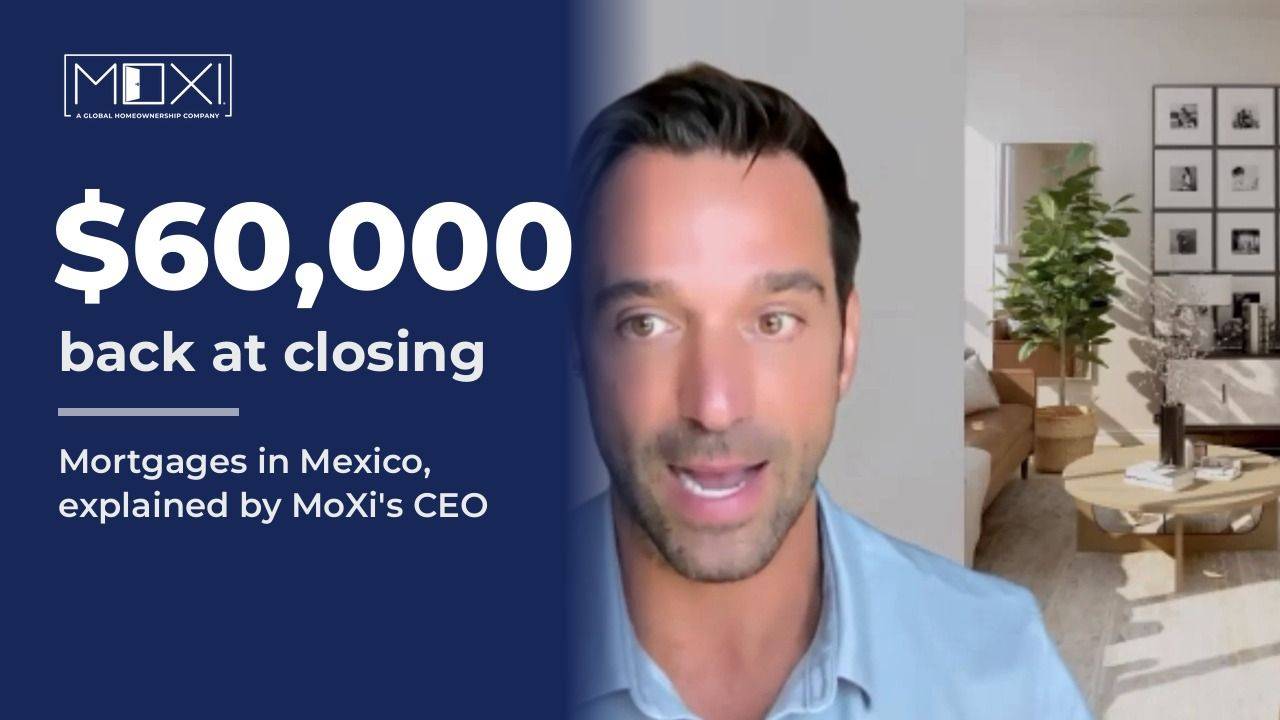
Alex’s tip works whether you use MoXi or not: ask the seller for a closing cost credit as part of your offer. Say a home is listed at $1.1 million. You offer $1 million with 6% back toward closing. That’s $60,000 toward your costs, on a house you already got for $100,000 under asking. (Jump to 11:45 in the video.)
Escrow on every loan
Some sellers, especially around Mexico City, still ask buyers to wire earnest money straight to a personal checking account. MoXi doesn’t allow it. Every loan closes through an approved escrow company. Escrow holds the funds, and both buyer and seller sign the disbursement instructions.
How the fideicomiso protects everyone
Foreigners buying near the coast or the border hold property through a fideicomiso, a bank trust. MoXi uses a version called a fideicomiso de garantía, a guaranty trust. It uses the same structure everywhere, including places like San Miguel de Allende and Mexico City where a trust isn’t legally required.

While the loan is outstanding, MoXi sits in the first beneficiary position. You’re second, either personally or through your LLC or trust. Pay off the loan and MoXi comes off. You also name contingent beneficiaries when the trust is set up, so your interest passes straight to family.
For the full picture on how the trust works, including the fifty year term and renewal, read The Fideicomiso, Explained.
One payment, in dollars
Borrowers pay principal and interest in U.S. dollars, plus a monthly impound. MoXi then pays the property tax, hazard insurance, and the annual trust fee when they come due. HOA dues are the one thing you handle yourself. There’s no prepayment penalty.
Property taxes help the math. Los Cabos runs about 0.25% to 0.3%. California runs roughly 1.1% to 1.2%.
Who it’s for
MoXi lends on residential property: condos, single-family homes, townhomes, buildings with up to four units, and some mixed-use. A legal closing in Mexico costs about the same on a $100,000 condo as on a $10 million home, so the numbers work best on higher-value properties. MoXi’s current minimums are a $350,000 property value and a $200,000 loan, and there’s no upper limit.
Alex’s two rules
Don’t sign a contract on vacation. Take a pause and make a phone call first. Get a seasoned agent who represents you, even on new construction.
Know the closing costs going in, and don’t pinch pennies on them. “You get what you pay for,” Alex said. Buyers who skimp on legal work pay for it later.
Book a complimentary discovery session with a MoXi mortgage advisor. No cost, no obligation, and you’ll leave knowing what your purchase would actually take.
MoXi®, A Global Homeownership Company
This article summarizes an interview in general terms and is not legal, tax, or financial advice. Loan programs, minimums, down payment requirements, and timelines are subject to change and to borrower qualification. Property matters in Mexico are formalized by a notario público, and the notario handling your transaction is the authority on your specific property.
Full transcript
This transcript has been lightly edited for readability.
Vin: Have you thought about getting a mortgage in Mexico, or are you looking to buy a home and considering a mortgage? Well, I have an expert in the mortgage space in Mexico. His name is Alex Koper, and he is from MoXi. He’s going to share his insights into the Mexican real estate market as it applies to mortgages. Alex, thank you for joining me. Maybe take a few minutes to introduce yourself, explain what MoXi does, and then we’ll get right into it.
Alex: Sounds good. Thanks for having me, Vin. I’m Alex Koper, the CEO of MoXi. We were just talking before about how a lot of people have different names for us. Some people call us MoXi Global or MoXi Mortgage. Our company is just MoXi. Our domain name is moxi.global, so maybe that’s where the “global” comes from.
The MoXi team is on a mission to make global homeownership possible for everybody. When we first started this business many years ago, we were looking at what people all across the world are doing when they’re buying property, whether a second home, an investment property, or even a primary residence, outside of their home country of citizenship. We were fascinated to find that, A, there really aren’t any financing options available to serve that need. And B, people really want expertise and guidance when they’re transacting in a foreign country. We’re meeting both of those needs with our process.
We initially got started helping U.S. citizens and U.S. taxpayers purchase, refinance, or cash-out refinance property in Mexico. We have our eyes set on more of a global stage, to help even more people in the longer term. So it’s a pleasure to be here with you, and I’m looking forward to our chat today.
Vin: Awesome. So you primarily focus on providing mortgages, and you started off in Mexico, from what I understand. It sounds like you’re looking to expand into other regions of the world, which is exciting. But this channel is more Mexico focused, so we’re going to hone in on the Mexican market.
In the past, most people who bought a home here in Mexico would pay 100% when they made the purchase, whether they refinanced their existing home back in the U.S. or Canada or however they did it. A mortgage in Mexico wasn’t really an option until a few years ago, or a little longer. MoXi has come in, and from my research, you’ve become one of the biggest players in the Mexican market for mortgages. There are other companies starting to offer mortgages in Mexico, but you seem to be the leaders in this space and probably one of the first entrants. So maybe touch on why you chose Mexico, and why you think it’s a niche market for people looking to buy homes here with a mortgage.
Alex: We initially set our sights on Mexico for a couple of reasons. One, it’s an incredible country, and I know we can both speak from personal experience. Two, it has a very healthy and mature real estate market, which surprises many people when I share that. Foreigners have been buying property in Mexico for decades, and it’s become more commonplace now. The real estate market is very mature and very stable.
There’s a Mexican federal index, published by SHF, that tracks home price appreciation in Mexican markets on an annualized basis. That index goes back to around 2005 or 2006, I believe. There have been home price increases every single year since then, despite various financial issues on a global stage. Even in the crux of the global financial crisis, Mexico still saw home price appreciation across the board. So it’s a very attractive real estate market from an investor, rental, or second home perspective. It’s also a beautiful, incredible place to have a second home or be a full-time resident.
That’s what initially led us there. We were also aware of the complexities foreigners face when owning property in a foreign country in general, and in Mexico specifically. Mexico has very specific laws around ownership of property by foreigners, particularly in restricted zones. Instead of being turned off by that, we doubled down on figuring out how we could operationalize it and give clients a home purchase or refinance experience similar to what they’re accustomed to in the U.S., and build tech around complying with all of the local laws in the various markets we’ve landed in across Mexico. That’s been really fun.
It’s also a great place for us to build out the global platform. We’re keeping in mind how we comply with all of those rules and regulations, and building out our vendor network across different markets in Mexico. By vendor network, I mean notarios, fiduciary banks, appraisers, title searchers, title insurance providers, hazard insurance providers, all of that. If that sounds crazy to think about, that’s exactly what we do. Clients come to us, they get the financing, but they also get that guidance and access to that network, and we handle it all for them from beginning to end.
Vin: Awesome. So it’s almost a full turnkey solution, from when a person identifies a home, to getting the lawyers and the notarios involved, and then your underwriting team vets the deal and approves it or not based on the individual’s criteria and credit score, which we’ll get into in a second. Let’s start with what a typical process looks like for someone who wants to buy a home here and have it financed with a mortgage. Walk us through it from beginning to close, and then how MoXi secures itself against the title of the property.
Alex: Good question. Our mortgage process starts pretty similarly to getting a mortgage in the United States. We typically work with clients even before they’ve identified a property. They want to get pre-qualified, or sometimes they just want to learn more about how it works. Our mortgage advisor team loves having those conversations. We’re very passionate about what we do. Oftentimes we’ll speak with clients weeks or months in advance of finding a property.
They go through a typical application process, very similar to what they’re accustomed to. It’s digital and secure. They complete the application, have a call with a mortgage advisor either before or after, and upload their documents securely into our portal. We’ve made a lot of enhancements to our portal, so it’s very user-friendly. They sign disclosures and upload income, asset, and financial documents. We order credit and do the initial credit underwriting, which is relatively quick. Sometimes it happens the same day, sometimes it takes a couple of days, but it’s very fast.
The rubber really meets the road when the property is identified and there’s a purchase agreement. That’s for a purchase transaction. We do a lot of refinance and cash-out refinance transactions too, for people who already own, and in that case there’s no real estate agent or purchase agreement involved. But when there is a property, that’s when the clock begins. The credit underwriting I just described happens in a matter of hours or days. You get a credit decision, and you can shop with confidence if you haven’t found a property yet. If you already have one, we move right into what we call the legal pipeline. That’s when we start evaluating the property itself.
I don’t want to bore your audience too much, but we look at all sorts of things. If the property is currently owned by a foreigner, it’s probably held in a fideicomiso or a fideicomiso de garantía. We’ll look at the trust that already exists and see if we can save our client money by modifying it. If not, we work on canceling the existing trust as part of the purchase and sale, and open a new trust with a new fiduciary bank.
We also work with a lot of clients buying new construction, so we’re working with the developer of the unit the client has already contracted for. Have they recorded their condo regime? Have they manifested the construction? Can a legal closing actually occur in accordance with Mexican law? We’re looking at all of those property-specific things. We’ve seen it all, in restricted zones and non-restricted zones, so we have it down to a science.
The typical timeframe from beginning to end at MoXi runs about 75 days. We had one in San Miguel de Allende, which is a non-restricted zone, that took about 22 days. We have some closings that go on for months and months, and that has very little to do with us and a lot to do with the seller or buyer. So it really depends.
I think that’s the biggest takeaway for anyone used to the process in the United States. The process here is very different, because it’s heavily dependent on that particular home: its history, how it’s currently vested, and how following the law in Mexico dictates how you prepare the closing for that specific property. That’s what we do really well, and it protects everybody involved, the buyer especially. If you get a MoXi loan, you walk away knowing that you own that property. It’s fully papered. It’s a full legal closing in Mexico, done in accordance with local law.
Vin: Which is actually pretty important in Mexico, because getting title and ownership, whether it’s land or homes, can be a challenge at times. I’ve heard horror stories where pre-construction deals fell through and people lost all their money, or someone bought a property and the seller didn’t disclose claims from other family members. These are typical issues that do arise, so it’s nice to have a layer of confidence with a company like yours that has to vet the deal to make sure you’re underwriting the right one. That makes for a pretty clean sale process.
In terms of cost, there’s the notary fee and closing costs on a property, and I’ve heard they can run pretty high, up to 7% or 8% of the property value. Is that something people can roll into the purchase and into the mortgage?
Alex: Pretty simple answer: yes, absolutely they can. At a minimum, on a purchase transaction, we require a 35% down payment plus closing costs, but the closing costs can be rolled into the overall transaction.
One pro tip, whether you’re working with MoXi or not, just a piece of free advice. What some of our clients have successfully done is negotiate in the purchase agreement for the seller to credit the buyer some percentage of the sale price in closing cost credits, which can help offset some of those fees. The fees are very high relative to what people are accustomed to paying in the U.S. I don’t think there’s any municipality in the entire country of Mexico that has transfer tax below 3%. So at a minimum, you’re paying 3% to the government just to transfer the title. Some markets are 4%, and some are even 5%. That’s a pretty significant cost.
So my pro tip for anyone: when you’re working with your agent or your attorney, think about asking the seller to give you a credit toward closing costs as part of your negotiated price, whether that’s new construction from a developer or a resale property.
Vin: So what would that actually look like? If I’m buying a home, could I ask the seller to inflate the price 5% and give me that 5% back to help cover closing costs? Is that roughly how it works?
Alex: Ideally, you wouldn’t have an inflated price for the home. You’d just ask for it in addition. I think there are some good deals in some markets right now, while in others inventory is very tight. But let’s say a property is listed for the equivalent of 1.1 million U.S. dollars, and you write an offer that gets accepted at a million dollar sale price with 6% back in closing costs. Just for round numbers, that gives you $60,000 toward all of your closing costs. So you got the property for $100,000 less than it was advertised for, plus an extra 6% to cover some of those hefty closing costs. It may cover all of them, but generally it’s going to cover most.
Vin: Sure. And I think the notario would handle disbursing those funds to cover the various expenses?
Alex: On a MoXi loan, we require the use of an escrow company. We have an approved escrow vendor list, very specific escrow companies that are used very commonly. Escrow handles all the disbursements. They receive the loan proceeds from MoXi, arrange the closing, and do all the disbursements, and the buyer and the seller both sign the disbursement instructions. In that way, it’s very similar to a transaction in the U.S. with escrow.
We run into this more in central Mexico and Mexico City: there are still some sellers who say, “No, just send the earnest money to my checking account.” That’s so foreign to us in the United States. We don’t allow that in our transactions. Our mortgage advisors often have calls with the seller and the seller’s agent to explain that escrow is safe and commonplace these days. Just a funny little anecdote there.
Vin: I’m glad you covered the escrow part, because I’ve heard horror stories of people giving deposits on a purchase, and then for whatever reason the deal falls through. Good luck trying to get that money back from the seller. It can be very challenging. Having an escrow intermediary hold the funds is always a value add for the buyer side, at least, and you ensure that it’s in place, which is another reason people should consider MoXi.
Just out of curiosity, let’s say someone has the money to buy outright. They don’t want the mortgage, but they want to use your services to make sure all the ducks are lined up: the escrow, the trust, and so on. Can they use your service for a straight cash purchase?
Alex: No. We’re not a closing company. But many people who could pay cash choose not to, for a variety of reasons. One is that you have to part with less. A lot of people don’t want to sell stock and realize a capital gain, or sell another asset they hold in the U.S. So having a little leverage, even if you want to put 50%, 60%, or 70% down, you can take a smaller loan, no problem. People tend to do that if they want to work with us. But we don’t handle cash purchase and sale transactions. It’s not part of what we do.
The other thing people really appreciate about MoXi is that we’re not just there for the first 90 days, and then we fund the loan and we’re done. We really partner with our clients over the term of the loan, in some cases 30 years. The loans are subserviced in the United States, and MoXi does in-country subservicing as well.
Clients remit their principal and interest in U.S. dollars, the regular mortgage payment. They also make an impound payment: property tax, hazard insurance, and the fideicomiso annual renewal to the fiduciary bank, divided by 12 and paid every month with their payment. The servicer holds those funds, and annually, or sometimes semi-annually depending on where the property is, MoXi pays the taxes from those funds to the municipality. So your taxes get paid on time, and your fideicomiso annual payment to the fiduciary bank gets paid on time. Your hazard insurance doesn’t lapse. We make sure it gets renewed and the premium gets paid.
So it’s a one-stop shop. You make one monthly payment in dollars, and your property in Mexico is taken care of. We don’t do HOA dues, that’s the one thing. But the rest of those critical things are included in the one monthly mortgage payment, and a lot of people really appreciate that. We also don’t have a prepayment penalty, so clients can pay down the loan to pay less interest. That’s a pretty attractive aspect of a MoXi loan, besides just getting the keys to the house. We’re there over the long haul.
Vin: So would the actual payment come from a U.S. bank directly to MoXi’s bank, so nothing goes through the Mexican banking system? Or is there an option for people who bank in Mexico, say they work here full-time and all their funds are here, to pay from a Mexican bank to MoXi in the U.S.?
Alex: That’s a really good question. We use a third-party U.S. mortgage servicer to service these loans: collecting payments, mailing statements, credit bureau reporting, all of those things. They offer ACH automatic payment. I believe it’s from a U.S. checking account, but I could be wrong. Maybe the routing and account number works from a Mexican bank. All of our loans are in U.S. dollars and all payments are collected in U.S. dollars, so it would have to be a U.S. dollar account, I would think. That’s something I could get back to you on. I don’t know off the top of my head. Typically, clients set up ACH autopay from their U.S. checking account.
Vin: Sure. In the U.S., and in Canada for that matter, if someone gets a mortgage, the lender usually has a registered claim against the property. How does that work in Mexico? If I buy a house and get a mortgage from you, does MoXi have a claim within the trust, or with the notario and the property? Can you explain what that looks like?
Alex: Good question. We use a special type of fideicomiso, the trust agreement commonly used by foreigners, meaning non-Mexicans, to own property in restricted zones in Mexico. We use it across the whole country. The special version we use is called a fideicomiso de garantía, a guarantee trust. That’s why you have the third-party fiduciary bank that services the trust. They charge an annual fee, the one we were just talking about.
Within the trust document itself, there are beneficiaries. A MoXi client, or anyone using any kind of fideicomiso for that matter, can hold their interest in the property personally or in an LLC, a trust, a corporation, or any sort of holding entity. MoXi, or its successors, assigns, or affiliates, is in the first place beneficiary position while the loan is outstanding. As soon as the loan is paid off, either because you’re selling the property or because you choose to pay it off early, MoXi gets removed and your name moves from second to first.
Another helpful piece of the fideicomiso is that you also have contingent beneficiaries. At the time the fideicomiso is created, you list those names. You’re basically instructing the third-party fiduciary bank holding the trust: “If I pass away, I want my interest in this property to go to my wife, my daughter, my son,” whoever it is. You put those names into the trust when it’s created.
Vin: So it’s the first creditor position?
Alex: Yes, I think that’s right. It’s the first place beneficiary under the fideicomiso. Then you hold second place, either in your name personally as a foreigner, or through your LLC, your trust, or whatever way you want to hold title. And then there are additional aspects of the trust that can be helpful.
Vin: For people new to buying homes in Mexico, the fideicomiso, the trust we keep mentioning, is usually required in restricted zones, which are 50 kilometers from the coastline, I think, and a certain distance from the border. What happens for someone buying in the middle of Mexico, where you don’t necessarily need a fideicomiso, but MoXi is providing a mortgage? Is there a special type of agreement that puts you first in line?
Alex: We actually use the same trust instrument. Even though it’s not required, because the property isn’t within 50 kilometers of a coastline or a border and the Mexican constitution doesn’t require a foreigner to have one, buying in Mexico City or San Miguel de Allende doesn’t preclude you from using one. So we use them across the country of Mexico, even in the zona no restringida. I probably butchered that last word, but across the country, we use the same trust instrument.
This sometimes prompts conversations with our real estate agent partners, particularly in San Miguel de Allende. We have these conversations often, because they ask, “What do you mean there’s a fiduciary bank? What do you mean there’s a fideicomiso?” When we explain it, it makes sense to everyone. If you were a foreigner buying in central Mexico, you might ordinarily not choose to use a trust. If you’re getting a MoXi loan, you have to. We set it up, so it’s not a lot of extra work for the buyer. It’s all part of the closing process. It’s unique to those areas, but it works exactly the same way.
Vin: Okay. So viewers should understand that there’s a yearly cost to having the fideicomiso. On top of the mortgage payments, there will be an additional cost for having that trust in place, which is good for people to know. Now, I don’t think you’re going to be mortgaging a cheap property. Is there a minimum dollar amount, or a type of property it has to be? Because you don’t really do commercial lending yet.
Alex: Correct. Generally, we do not. We’re residential only, which could include a condo, a single-family home, a townhome, even a one to four unit mini apartment complex or a duplex. We will lend on mixed use. We have specific guidelines, like some percentage of the air-conditioned square footage has to be residential, but we will lend on mixed use. So we have some flexibility with respect to collateral, but not commercial.
To your point about overall price, doing a closing the right way in Mexico is expensive and a lot of work. You do it hopefully once, and you enjoy the benefits over the long term, including financial ones. Property taxes are a fraction of what they are in the U.S. In California, they’re usually around 1.1% to 1.2%. In Texas, it’s probably double that. In Los Cabos, it’s something like 0.25% to 0.3%. Then there’s hazard insurance. Right now I’m in Southern California, where you basically cannot get homeowners insurance to save your life. You have to use the state-mandated one. In Mexico, hazard insurance is reasonably priced. So there are a lot of benefits.
But upfront, it’s expensive and it’s hard. It’s a lot of work to do it the right way, follow all the laws, and protect yourself. And it’s about the same amount of work on a $100,000 condo as it is on a $10 million home. A lot of those costs are fixed. So oftentimes it doesn’t make financial sense to take out a mortgage and do all the work required to own it legally on a lower priced property.
We want to expand this and be available to more people, and we do intend to, but we have to make sure it’s economically viable for everybody. Today, we generally work with clients transacting on a property valued at about $375,000 to $380,000 and up. We don’t have an upper limit. We’ll go as high as you want. We tend not to be a great fit for clients buying a property that’s, for example, $200,000 or $100,000. It just doesn’t make a lot of financial sense. So that’s generally where we start, which means a mortgage loan amount of $250,000 or greater. It’s not a hard and fast rule. We definitely help people with smaller loan amounts sometimes, and that’s fine. Ultimately, our goal is to help people realize this dream of global homeownership, and we’d love to do that for everyone. But oftentimes, from a financial perspective, it makes more sense on a higher priced property.
[Editor’s note: MoXi’s current minimums are a $350,000 property value and a $200,000 loan.]
Vin: Awesome. You and I have talked about commercial lending here, and I’ve had conversations with others. I think there’s huge potential in the Mexican market for commercial real estate and business loans, but that’s a subject for another interview altogether. We’ve got a few minutes left, so give us a quick wrap-up: your best tips and advice for someone considering a purchase in Mexico, why they would get a mortgage, and how to make the process smooth.
Alex: I’ll quickly address the commercial piece. I agree with you. I think it’s a really great opportunity, and a lot of the work we’ve already done in building MoXi would support something like that. We’re regularly working with our capital markets partners and looking for additional financing facilities, so we can originate loans on different types and price points of property. We really want to make this bigger and better for everyone, and we’re actively having those equity and capital conversations with partners. So let’s definitely have another chat about that.
As for tips, my first and biggest one: if this is the first time you’re buying property outside the country you were born in or live in, take a deep breath, do some research, and talk to some people. You can call us at MoXi. Make sure you’re properly represented, with a really seasoned, really good real estate professional on your side, even if it’s new construction. Try to avoid going on vacation, looking at some houses, and signing a contract because you’re swept away by the beauty of an exciting new condo development. Always take a pause and make a phone call. Call us, and we can try to talk you down a little. Remember that you’re transacting in a foreign country. Even the most well-meaning developers, real estate agents, and real estate attorneys may not realize they’re missing a step in protecting you and your best interests. So make sure you’re well represented. That’s number one.
Number two: make sure you understand the upfront closing cost piece. It’s in stark contrast to what you might be used to if you’ve bought property in the U.S. before, so you really need to prepare financially. This is not the time to pinch pennies, because you get what you pay for. When you’re transacting in a foreign country, it’s really important to get top-level advice, top-level service, and a great vendor network. Believe me, if you try to save a little money here, you’re going to end up paying for it down the line. Those are my top two tips. I hope that’s helpful.
Vin: Perfect. Thank you for sharing all that insight. I’ll share contact details for people who want to reach out to MoXi, or they can reach out to me and I’ll be happy to forward their information. Thank you for your time, Alex, and for all the detailed information.
Alex: Thank you for having me, Vin. This has been a really fun discussion, and I look forward to more.
Vin: Absolutely, especially on the commercial side when that starts rolling out. Take care, everyone. Enjoy your day, Alex, and we’ll talk soon.
Alex: Thanks, Vin. Bye.
MoXi® funds and services loans in USD and is a regulated mortgage company in Mexico, with compliance maintained throughout the life of your loan.
If you are weighing a purchase or refinance in Mexico, a short discovery call is the fastest way to get clear answers for your situation.